top of page

Horse Head
Photographer: Lonnie Martin Design: Adalia (Costumes), Cindy Marie Martin (Set), Joseph Birchland (Lights), Marissa Mallow (Makeup)

Falling Down Hill Pt. 1
Photographer: Lonnie Martin Design: Adalia (Costumes), Cindy Marie Martin (Set), Ryanne Fury (Lights), Marissa Mallow (Makeup)

Overhead Printout
Photographer: Lonnie Martin Design: Misti Igo and Sophia Van Nederveen (Costumes), Aubrey Helene Neumann (Set), Eric Armstrong (Lights)
Horse Head
Photographer: Lonnie Martin Design: Adalia (Costumes), Cindy Marie Martin (Set), Joseph Birchland (Lights), Marissa Mallow (Makeup)
1/6
Props & Puppet
Design
Onstage actors interact with props or properties. These movable objects are distinct from costumes, scenery, and lights, though at times the lines blur, as is the case with parasols and purses, large props like chairs, and practical lights such as lamps. Because of this ambiguous positioning, the responsibility for props is often shared. When we hired Adalia to manage the costume shop in Fall 2022, I shifted my attention to props and helped coordinate these efforts.

Design: While similar to costumes, the design process for props is more emergent as additional props are often added during the rehearsal process. Once a props list is compiled, items must then be pulled from stock, made, or purchased. Sometimes props designers also provide "dofers" items that can substitute for the final prop during the rehearsal process. A props master then creates props tables, which bear specific places for each prop. Since Fall 2022, I have designed - either by myself or in collaboration with a student - props for all of the shows that I have directed as well as pulled props for shows directed by others. This props list for Cinderella provides a strong example of the work involved in designing props for a musical.
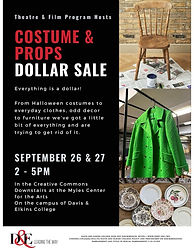
Organization: When I took responsibility for props, our props were stored in two overflowing storage spaces. Together with student workers, we have sold or disposed of overstock, rearranged props to make better use of vertical space, and have almost consolidated all props into a single storage space. In Fall 2024, we hosted a costume and props sale, which further benefited the campus and local community.
Student Opportunities: We've had a number of students help with props as part of their work study. The work, whether it be creative or organizational, requires a great deal of initiative as well a problem-solving, both skills that will serve our students well in the future. Most recently, Introduction to Design and Technology students helped to make props for Cinderella - a hands-on learning experience in which the students saw the fruits of their labors utilized on stage.
Puppets provide a low-tech method for high-quality spectacle. Students have benefitted from the opportunity to both make puppets and manipulate them on stage, learning that exceptional storytelling doesn't require an exceptional budget. Although I've used puppets in the majority of the shows I've directed at Davis & Elkins, I have used a variety of techniques to further expose students to the visual possibilities.

Overhead Projection: Following a workshop with Manual Cinema, I incorporated overhead projection in Failure: A Love Story. Title cards harkened back to silent films and transported the audience through time and across the United States. Meanwhile, silhouettes (left) - which I drew by hand and cut out with an exacto knife - brought clocks, gardens, and rivers to life. To help the actors track the over 50 projection cues, I created projection lists for both the house and river side of the alley stage.
Physical Puppets: I specialize in cardboard puppets (above)- created from scratch or interpreted from purchased designs. At times, we've also made props from found objects like inner tubes and foam noodles (right). Much like with props, this serves as a strong example for students, both watching me problem-solve in the moment and coming to their own conclusions through trial and error.


Shadow Puppets: As a great admirer of Pig Pen Theatre Co. and their original work The Old Man in the Old Moon, I had long wanted to incorporate shadow puppetry into my work, and Peter and the Starcatcher provided the perfect vehicle. I identified images and worked with students to cut out the silhouettes for ships, flashbacks, and falls (left) alike. The cast, who the show casts as narrators as well as characters, then manipulated the puppets and flashlights to depict the story on the three sails draped across the stage.
bottom of page